Fabulating Bog Girl
Queer Entanglements of Body and Land Histories in More-than-Human AutoFiction and Design
This project asks what shared stories cut across the treatment of lands, bodies, and the design of technologies that mediate relations between those different human/non-human bodies. Using first-person storytelling and fiction, I explore how binary readings of land and bodies can be deconstructed through non-binary reframing, and how this might reimagine technology design with non-binary values and enable caring and respectful treatment of non-binary bodies.
Publications:
Heidi Biggs. 2025. Fabulating Bog Girl: Queer Entanglements of Body and Land Histories in More-than-Human AutoFiction and Design. In Proceedings of the 2025 CHI Conference on Human Factors in Computing Systems (CHI '25). Association for Computing Machinery, New York, NY, USA, Article 771, 1–13. https://doi.org/10.1145/3706598.3714067
(Best Paper Honorable Mention Award)
The project Fabulating Bog Girl was inspired by the intersection of my PhD research with my experience of undergoing a difficult women’s health medical procedure as a non-binary person. These experiences combined to shift how I saw More-than-Human entanglements between land and body from a queer, non-binary perspective.
First, in my research on the American Midwest and computational agricultural, I quickly learned that much of the Midwest was historically covered in massive wetlands which were mostly converted to farmland through ditches and channelization, the largest of the was the Kankakee marsh in northwestern Indiana, which I focus on in this project. These massive changes in the landscape relied on agricultural and infrastructural technologies, but were underpinned by certain beliefs about land use. Land use for agriculture followed a binary logic of separating land from water to achieve agricultural productivity, as well as prevailing beliefs (by European settlers) that wetlands were ‘evil’ places that needed to be tamed.
Drawing connections more closely to my own embodied experience, wetlands also represented, to me, indeterminate, non-binary spaces, neither water nor land, rich and abundant with resources, that were not valued on their own ecologically rich terms. I started to connect wetland’s histories with my own bodily history when I underwent a difficult women’s health medical procedure as a non-binary person.
In the consultation for my procedure, doctors wouldn’t acknowledge harms beyond its impacts on reproduction, even as I brought them emergent research and that showed its broader impacts. They often stated it was because there were no medical studies on these other impacts, but I wondered if there simply wasn’t research available because women’s health outside of reproduction is widely understudied. I felt due to this lack of information and recognition, I was denied informed consent, and that the information available to treat me was based on a binary logic of male/female that centers reproductive outcomes in women’s health above any other outcome.
The relationships I was drawing between the VALUES of how women’s bodies are framed and how land is conceptualized rely on binary separations that reinforce a certain type of productivity. There are then a bevvy of technological tools and information/research that are shaped by these foundational beliefs or ways of seeing the world. These types of arguments are not new, they have been espoused by Feminist Science and Technology Studies (STS) scholars and queer ecofeminists for decades.
In this work, I use a first-person auto-fiction to illustrate and develop theory around what non-binary more-than-human entanglements might look like and feel like between land and body by writing the short story Bog Girl.
The plot of Bog Girl is thus:
In Bog Girl, Tara (the human protagonist) goes to a small park at the site of the Kankakee Marsh which had mostly been channelized and turned to agricultural lands. In this park, Tara claims they are visiting to find the wetlands and share an experience of being cut - Tara in a medical procedure and the former wetland through channelization. Tara hoped to feel a connection to the wetland, but they don’t quite sense anything.
However, suddenly, Tara is pulled into a ditch that runs between the wetland park and an agricultural field by grassy tendrils.
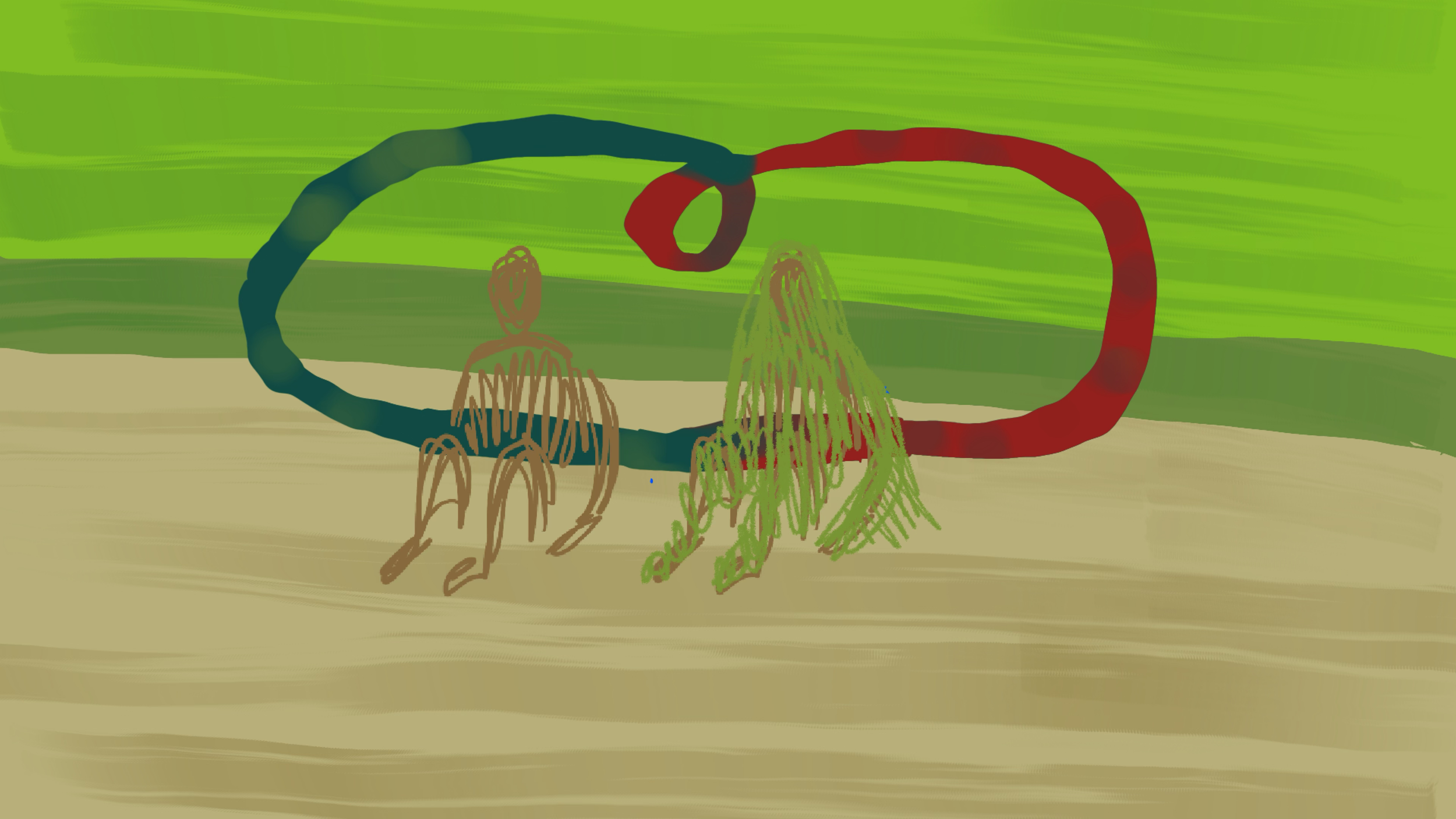
Underwater they trade blood and water with the marsh, co-animating a grass-covered humanoid which Tara calls Bog Girl. The Bog Girl and Tara wake up on the banks of the ditch together, mirror images of each other. Frightened, Tara runs from the bog girl.
Eventually, however, they face off, and end up blending into a shared body where they can collectively experiences their ‘cuts’ in turn. One being the channelization of the marsh, and the other being a medical procedure.
They ultimately end up encased together in mud to heal. The story reflects on the impossibility of consent for non-binary bodies systems build on binaries, shared bodily trauma, grief and shared healing.
——
The story illustrates four points. First is a mutual seeking out of solidarity between non-binary bodies (regardless of being human or non-human). Second is the construction of a human/non-human entangled body through these bonds of seeking or desire. Third is how their shared grief exposes the binary logics that cut across both bodies in violent ways and violent outcomes. And fourth, is the possibility of connecting across this hybrid body for shared grief, healing, and rest.
Ultimately, this paper begs the question, how can we design against a dominant ideology that permeates technology at such a deep level it is hard to sense or grasp for most people? The answer seems to be in listening deeply, to our own bodies, to the land, to the resonances between, and telling new stories that can shift understanding.